Australia’s shrinking domestic research pipeline puts STEM workforce at risk
New figures showing a 15 per cent decline in domestic research students over the past decade underscore the need for greater investment in PhD stipends, scholarships and STEM career pathways.
New figures showing a 15 per cent decline in domestic research students over the past decade underscore the need for greater investment in PhD stipends, scholarships and STEM career pathways to build sovereign capability, according to Australia’s leading tech and engineering Academy.
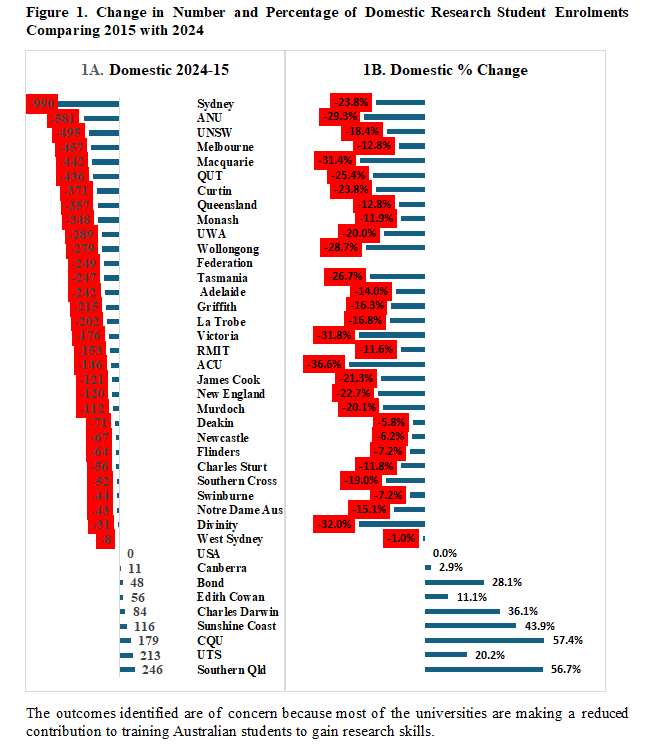
Australia is facing a growing gap in the pipeline of domestic researchers and STEM professionals, with new analysis showing the number of Australian students enrolled in research training programs fell by 6,511 between 2015 and 2024.
The analysis of 40 Australian universities by University of Melbourne Emeritus Professor Frank Larkins found that 32 had fewer domestic research students in 2024 than a decade earlier. While international research student numbers increased by 6,827 over the same period, the overall number of research students increased by just 316.
Figure 1 from Professor Frank Larkin's analysis on domestic research students
The Australian Academy of Technological Sciences and Engineering (ATSE) said the new analysis highlights the urgent need to make research careers more attractive and accessible to Australian students, particularly in areas critical to the nation’s future prosperity, security and resilience.
ATSE President Dr Cathy Foley AM PSM FTSE FAA said Australia could not afford to allow financial barriers to prevent talented Australians from pursuing research careers.
“Australia needs a strong pipeline of homegrown scientists, engineers and technologists to tackle the challenges ahead, from energy and climate change to critical technologies, advanced manufacturing and health,” Dr Foley said.
“Yet these figures show that fewer Australians are choosing research training, at a time when we need more people with advanced STEM skills, not fewer.
“Financial pressures are one of the barriers facing students considering a research career. If we want talented Australians to pursue PhDs in areas of national priority, we need to make that pathway viable.”
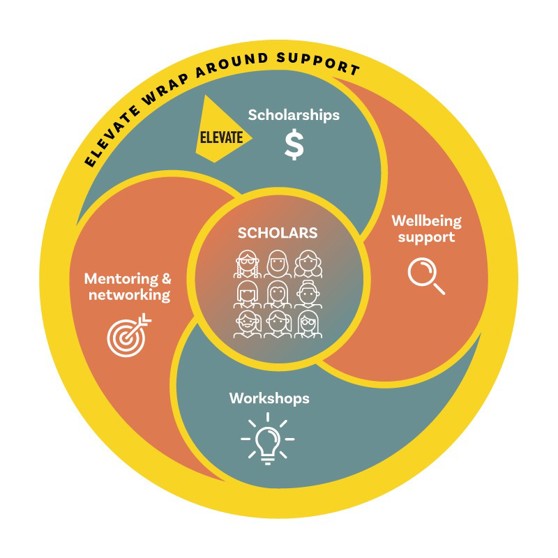
Elevate's wrap-around approach provides support that helps scholars thrive throughout their studies.
ATSE’s Elevate: Boosting diversity in STEM program demonstrates what targeted support can achieve. The program provides women and non-binary people undertaking university study in STEM with scholarships alongside peer-mentoring, professional development, wellbeing support and industry connections.
Elevate maintains a 96 per cent retention rate, helping scholars stay in STEM and progress towards careers in research and industry.
Government funding currently supports new Elevate scholarships through to 2027, but continued investment from Government and industry would be a practical, evidence-based investment in the people Australia needs to deliver its Future Made in Australia.
In March, ATSE welcomed the Ambitious Australia report's recommendation that the Federal Government increase PhD stipends to $50,000 per year. The standard Australian Government Research Training Program (RTP) minimum stipend currently sits at $34,315 per year.
PhD students are at the heart of Australia’s research effort and it is un-Australian to expect them to help drive innovation while living below the poverty line.
ATSE President Dr Cathy Foley AM PSM FTSE FAA
“The Federal Government has an opportunity to strengthen Australia’s research pipeline by making PhD training a realistic option for talented Australians.”
Elevate: Boosting diversity in STEM
Elevate aims to address inequities in STEM through comprehensive scholarships enabling more diverse women and non-binary people to access tertiary STEM education, professional skills development and STEM leadership opportunities with industry and academia.