Coming full circle — how a mentee becomes a mentor
Tong Chen was IMNIS’s very first mentee, as a young PhD student in agriculture. Ten years on, he’s become a mentor of his own.

Tong Chen was IMNIS’s very first mentee, as a young PhD student in agriculture. Ten years on, he’s become a mentor of his own.
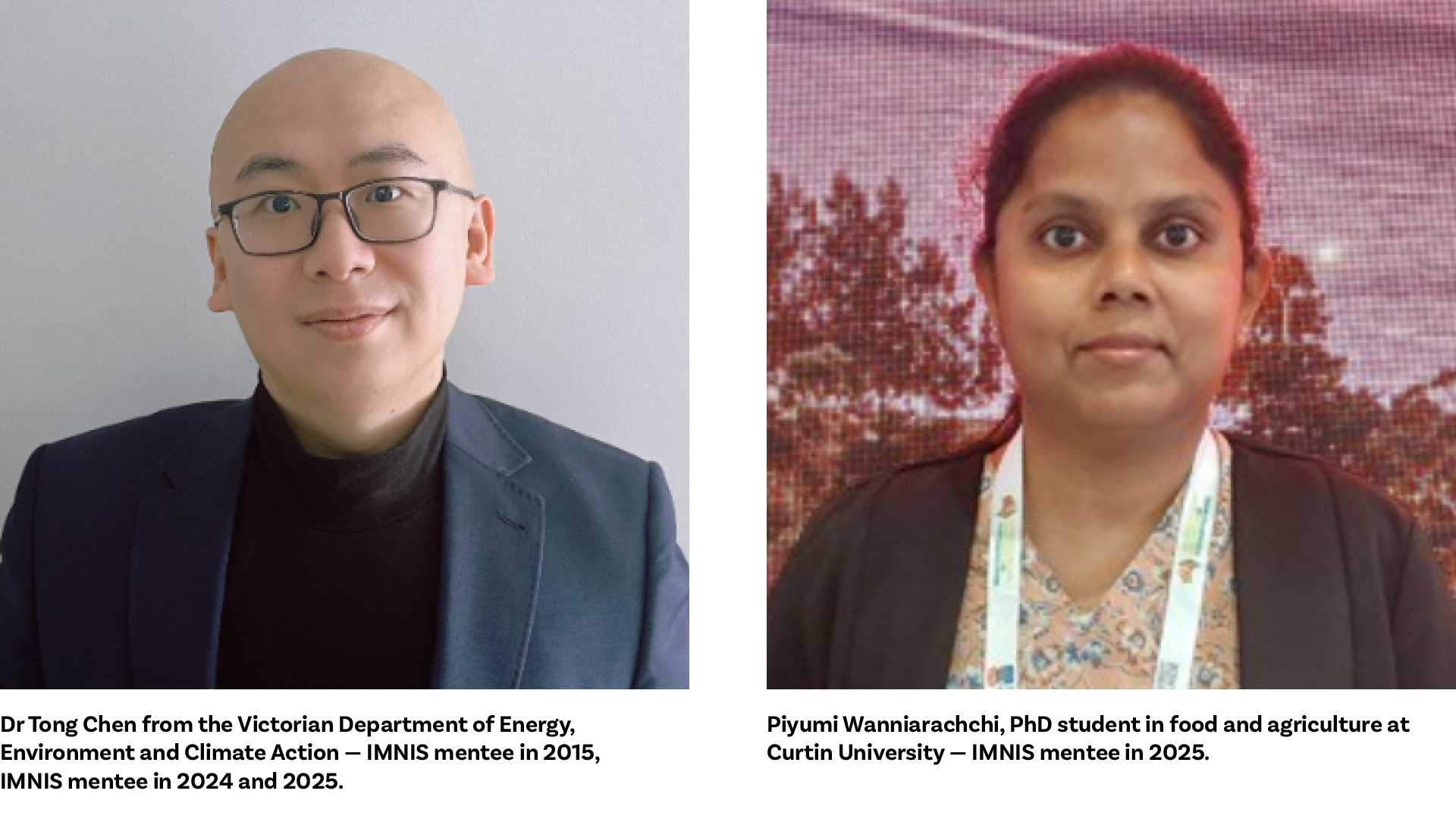
Tong Chen was IMNIS’s very first mentee, as a young PhD student in agriculture. Ten years on, he’s become a mentor of his own. Earlier this year, his latest mentee Piyumi Wanniarachchi reached out with praise and gratitude for the guidance he shared with her.
Piyumi said, “As part of the IMNIS 2025 program, I was matched in March 2025 with my mentor, Dr Tong Chen, from the Victorian Department of Energy, Environment and Climate Action. I’ve gained rewarding insights from Tong on the essential skills sought by industry, the importance of building genuine connections and the need to build effective communication skills as some of the key tips for better industry engagement. I'm excited about the rest of the journey to further strengthen my industry know‑how, sharpen my professional and communication skills, and expand my STEM network. I’m thrilled to highlight our mentorship story and showcase how IMNIS empowers researchers to confidently bridge academia and innovation."
Tong: It’s probably more than just a conversation, it will be just through the overall engagement for me with my mentor, Rosemary Richards [Chair of the Australian Oilseeds Federation and Sustainable Grain Australia]. Back then, I was in my third year of my PhD study, and when I was paired or matched with my mentor, who came as an industry leader in agriculture, I was really unsure of what I'm going to do. So my very first question to my mentor was, what should I do? It's an open question, and really the answer, or the feedback I got from her was like, no one could tell you what to do, except yourself. It was a virtual meeting between me and my mentor back then.
But I think the two things about me at that stage was I'm not sure what the future looks like. So if I pursue my academic career, I kind of have a blurred picture of what that would look like. I'm going to do a postdoc, going to try to secure some research findings, and in the future, maybe get to university or research institutes — that type of journey. What if I jump out from a university and move to industry or even government or other areas, what would everyday work or life be for me? And would that be something that interests me?
I guess that would actually be the question that I want to know. So later, I think I shifted my questions or my conversations with my mentor in a slightly different way. Really started asking about what her everyday work life looks like, even in her earlier years. So like people like myself, when I try to step up from academia, what are the potential opportunities? I'm not talking about job opportunities. But like, if I go into industry, what type of work that would fit my background, and what will that look like to me? So from there, [I saw] there is a much bigger world than academia, that I could utilise my skill set and really explore the wider STEM space. So I guess this whole thing is really the turning point for me. It made me decide, okay, I can do something more than research.
Tong: So from the first engagement, I took some casual work with industry bodies like a contract work, started getting into policy and market intelligence. Then later I secured a permanent position with the Victorian Government. I'm still doing similar things. I got promoted over the years within the Victorian Government, but still within a very similar space. Guess my journey led me to here, though, this is also a reason why I'm really grateful and really appreciate my experience with IMNIS.
Tong: The challenge was, I guess, a hesitation inside me back then. Like most of the students at the time, it is normal. It's like pretty much a comfort zone type of thing for me to pursue research, and I've been offered a visa with a postdoc position from the lab I was seeing. So career or job-hunting wise, it's kind of secure if I keep doing what I was doing. So jumping out from the comfort zone needs a bit of courage. Need a bit of insight from others. Thank my mentor back then, she definitely provided me with that level of self-confidence inside of me. So okay, I'm not afraid of giving up this two-year postdoc opportunity. I need to explore something else, because deep inside of me, I know I want to do something different, other than academia.
Jumping out from the comfort zone needs a bit of courage.
Tong: I guess I never feel ready to be honest, it’s not a sense of that I'm ready or I'm the expert in this. It's more a sense, like a responsibility to me, because I feel that I still remember those years when I transferred out from academia. What that feels like to me is this uncertainty that keeps you awake at night, but it's really about coming out from an area that you've been working in years and jumping into something different. I know people who participated in IMNIS probably would already start having these little thoughts within themselves — I want to do something different.
The information sharing or experience sharing would empower them more. My story or my own experience could probably tell people how you can manage it. There is no right or wrong way of doing it, but me, at least, I can demonstrate to them it is not scary to step out from academia.
Tong: I wouldn't use the word ‘training’, it’s more like, I can teach people something, I can create the space for them to allow them to self-reflect on things. I've been paired with a couple mentees through the program now, and most of them are not in the similar area as what I'm doing these days. That means I wouldn't be able to provide them direct industry insights or job insights, because for most of the mentees, the question they ask is, what will my next job look like?
So for them, I guess my job as a mentor is really to create that space or give them some insight, or information that says these are probably the job opportunities you're looking at. Not thinking of a particular job, but a job that you can utilise your skill set or the training or the way of thinking that you gained from your PhD years and which give you a great advantage or improve your competitiveness in a professional workspace. It's really about that shifting or encouragement that I can pass on to them, rather than a direct message saying, ‘Oh, you can do this job.’
Tong: It's definitely an evolving situation. When I started as a mentor, I did ask Laura [ATSE STEM Careers Strategy Manager] about what was my preference: I could help someone from a biomed or agriculture background, because that's where I came from. And so people, when they start talking about biomed or agtech, I know what it is. So I started with the idea of ‘how can I directly fit them’. The situation evolved, my own thinking, as I got more and more mature over the journey. Then I realised these smart young people, they don't really need me to tell them the next job opportunity. They need people to tell them what things they don't know from their everyday life. They want to know ‘what would my job look like as a government regulator?’, ‘who are the people I work with?’, ‘what would the everyday work life look like?’ And from there, they will find their own way to grow. So that's definitely an evolving situation for me, and it is a self-learning process as well.
It's really about that encouragement that I can pass on to them.
Tong: I guess one moment, my mentee’s name is Piyumi. So she is from WA, from Perth. I'm in Melbourne. So we're not in the same city. I haven't really met her in person yet. And through all these online or virtual communications I had with her, it was the moment when she gave me her feedback, saying, ‘Oh, thank you. You helped me a lot’ before I self-realized what area that I actually can help her.
What I have done is just sharing my insights, try to answer her questions and provide feedback to her own situation, she started telling me the little wins, little achievements she made at university, which is fantastic. I think everyone deserves a little celebration of all these little wins, it might not be significant. All these small things lead to something bigger. And so from that conversation, I started to value myself. That also made me feel like this program really can benefit both ways, not only the mentee and for people like me, I'll consider myself in the process of pursuing my own career development as well.
It gives me the self-reflection of leadership. I mean, I manage people on a daily basis and my own work. But this is different. This is not about tasking. This is about empowering a young professional. So as a mentor, I would say, if I can pass the message to anyone who is in a similar situation to me, like earlier middle management people, this is a great opportunity for better self-reflection.
Tong: It's definitely a privilege and a bit of luck. When people kicked off this program, it's a pilot program at first. And my area was agriculture, so I was lucky. It started with A and there might be couple people in agriculture, and my surname starts with C, so that’s how I became the first one! So yeah, couldn't complain. Life just gives you all these little surprises from here and there.
Tong: Networking is important. My mentor actually told me a thing. One sentence that I still remember is that ‘everything is an interview.’ This happened when I asked her about my first interview with industry. I didn't get the job at the end of the day, I got an interview opportunity, but they picked someone probably who had more experience over me, but that's all fine. My question back then to my mentor, like, ‘what should I prepare for the interview.’ Because for academia, you kind of know, there’s your publications, your research work. Naturally, they know you're good researcher, and then they give you the opportunity for that interview. My mentor actually told me ‘Everything is an interview.’ So that's very true. It's all about impressions, rather than connections, people see you as a positive, friendly individual, holding a very strong work ethic, and that's just really going to lay the cornerstone for everything. For me, I've been on the interview panel side many times now, as I was on the other side being interviewed many times, especially in my own earlier years. It's really not about the technical knowledge. We can always train people with the technical knowledge — that is not something lacking in any existing team.
It's about finding the right person with the right personality that can do the job, can fit into the team and has enough history, good history, records and background to demonstrate that that individual can be a quick learner and can just help the team fix all these issues that they're facing. And that is really something I wasn't told when I was at school, but that's something I gained through this program.
This is about empowering a young professional, and this is a great opportunity for better self-reflection.
Laura – ATSE STEM Careers Strategy Manager: I just want to thank you, Tong, for sharing that, and I have to say that a testament of how good of a mentor you are and the impact you're having on Piyumi is that she's the one that reached out to us, to say ‘I would really like to be part of the story, because my mentor has changed my life, and I want to celebrate our story together.’ Not every mentee does that, so I think that's also a little bit of that reassurance that you have opened her world in new ways that I don't think would have happened without your support.
Tong: That's really good to hear from you. I talk with Piyumi regularly. We do have monthly meetings these days, I guess for me, this is really another level of satisfaction beyond the everyday work level of satisfaction, since this came naturally from someone that, you know, I want to see the growth in her.
I think we share something similar. We are first generation Australians. Not sure about her, but I'm the first generation Australian in this country. I have some more challenges, other than a local student of domestic students, language barriers, cultural barriers, all those things so I think that really made me more grateful with the program, it opened doors other than the traditional university postdoc path, and allowed me to explore and find out what I'm interested in the most. I think I feel the same as Piyumi, a good mentor changed my world, and if I could just pass that on to someone else, that's fantastic.
A good mentor changed my world, and if I could just pass that on to someone else, that's fantastic.

Diversity and Inclusion
Reconciliation Action Plan Equity, diversity and inclusion policy Diversity & Inclusion ToolkitConnect


Australian Academy of Technological Sciences & Engineering
Level 2, 28 National Circuit Forrest ACT 2603
+61 2 6185 3240 | info@atse.org.au
ABN 58 008 520 394 — ATSE is registered with the Australian Charities and Not-for-profits Commission,
and is a Deductible Gift Recipient (DGR).