30 January 2026

Submission to the 2026 Inquiry into funding and resourcing for the CSIRO

CSIRO and other publicly funded research agencies provide economic returns to the nation, help inform better decision making, support diplomatic efforts and produce isotopes for medical use.

Read the CSIRO submission

A consistent, long-term financially realistic and sustainable solution is needed to unlock the full potential of Australia’s publicly funded research agencies to contribute to economic and health outcomes and resilience.

Australia’s publicly funded research agencies (PFRAs) are the backbone of Australia’s research and development (R&D) ecosystem. PFRAs allow government decisions to be built upon data and evidence, manage facilities for the entire research sector, support industry connections with applied research to build economic resilience and growth, and provide a pathway for the government to set a research agenda to address issues of priority to the nation. Recently, cuts have been announced to programs and staff across several PFRAs, including the Australian Nuclear Science and Technology Organisation, and the Commonwealth Scientific and Industry Research Organisation (CSIRO). Near the end of 2025, CSIRO announced the loss of 300-350 staff members, following more than 800 job losses over the 18 months prior.

This loss of expertise and capacity across Australia’s PFRAs will directly and indirectly harm our nation’s goals and economic prosperity, and leave the nation less able to tackle the major challenges of our time. There is an urgent need for increased, long-term investment in PFRAs, as well as in the broader R&D ecosystem in Australia.

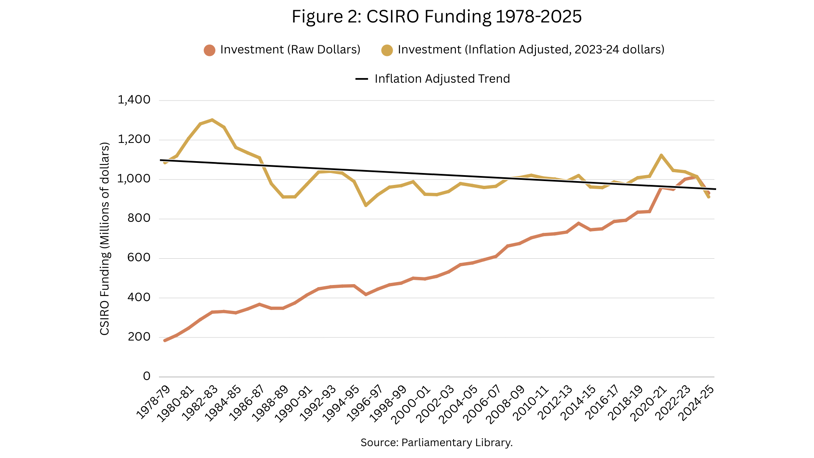
A graph showing funding for CSIRO dropping from 1978 to 2025 in inflation adjusted terms, with a downward trendline showing today's funding is below 1 billion dollars per year.

To stabilise the PFRAs that support an effective R&D ecosystem in Australia, ATSE provides the following recommendations for consideration:

Recommendation 1: Ensure the 2026 National Research Infrastructure Roadmap facilitates sufficient investment to maintain and operate NRI facilities, including those run or supported by CSIRO.

Recommendation 2: Set and progressively work towards a target for appropriate long-term budget for CSIRO and other PFRAs to enable them to meet the government’s expectations and deliver against the National Science and Research Priorities.

Recommendation 3: Leverage implementation of the Strategic Examination of Research and Development recommendations to bring total government investment in R&D into line with international standards and Australian aspirations.


Statement given to Senators – Friday 13 March 2026

Good afternoon Senators, we would first like to take a moment to acknowledge the traditional custodians of the land we are meeting on today, the Ngunnawal and Ngambri peoples, and reflect on their long history of achievement as Australia’s first scientists and technologists. We pay our respects to Elders past and present.

Thank you for the opportunity to address you today.

Publicly Funded Research Agencies, like CSIRO, form the backbone of Australia’s science, research and development system

We’re all aware of the impact CSIRO has had on Australian science and technology in the past – Wi-Fi, Aeroguard, the cervical cancer vaccine, polymer banknotes – the list is endless.

But even now , CSIRO continues to make an impact – through research on drought-resistant crops, disaster prepardness, and smarter health care. They are looking at using AI to predict the spread of bushfires. Lower-cost solar to accelerate decarbonisation. And they were at the front lines of protecting us from COVID-19, through essential work on things like drug screening.

But CSIRO has been doing this as it’s real funding has continued to fall.

Analysis of data from the Parliamentary Library shows that since the 1978-79 financial year, real funding for CSIRO has fallen by an average of over $3M a year – that’s over $172M lost in 2024-25 alone.

So it’s no wonder that CSIRO has cut over 800 jobs in the past 18 months and is now planning to cut up to 350 more.

As the same time, the rest of the R&D sector is also facing declining funding.

Research funding as a proportion of GDP now sits at 1.68%. In South Korea its 4.9%. The OECD average is 2.7%. That means there is no space in our R&D system to pick up this lost capacity. There is no safety net.

This long-term underfunding of Australian R&D is harming Australia’s productivity and competitiveness – weakening our economy for future generations.

Our economic complexity is falling. Productivity has stagnated. Research and development are the solution. Every dollar spent on R&D returns $3.50 to the economy – for CSIRO projects that’s up to $8.80.  Now is the time to invest in R&D both at CSIRO specifically and across the sector as a whole.

While we await the release of the Strategic Examination of Research and Development, and look forward to their suggestions for how to strengthen our R&D sector, the 350 CSIRO researchers who face losing their jobs cannot wait for the SERD to be implemented.

It doesn’t take a year-long review to see that proper long-term funding for R&D is needed.


ATSE Priorities Research
18
November
CSIRO cuts undermining Australia's research future

Today’s announcement of even further cuts to jobs and research at the nation’s science agency CSIRO is disheartening news for the research community and the Australian economy.

Research translation
Industry & innovation
Policy